この章の目標
直角三角形の三角比を定義し、その値が角の大きさだけで決まる理由を、相似から説明できる
三角比を単位円の上の点の座標で定義し直し、鈍角や一般角の三角関数の値を求められる
弧度法(ラジアン)で角を測る理由を説明でき、扇形の弧の長さと面積を求められる
三角関数のグラフをかき、周期や対称性を単位円から説明できる
加法定理を証明し、そこから 2 倍角・半角の公式と三角関数の合成を導ける
三角方程式・三角不等式を、単位円やグラフを使って解ける
前提 :P2 第3章 式の展開・因数分解と平方根 、P2 第4章 二次方程式 、P2 第5章 関数 、P2 第6章 図形と証明 、P2 第7章 円と三平方の定理・空間図形 。
対応する科目 :数学 I(5.1 ・5.2 節)、数学 II(5.3 節から)
坂道の「勾配 10%」の標識、離れた場所から測る木の高さ、コンセントの交流の電気、スピーカーの音。どれも三角比や三角関数で表されます。この章では、直角三角形の辺の比としての「三角比」から出発し、単位円 → 一般角 → 弧度法 → グラフと段を踏んで、sin \sin sin
「sin 120 ∘ \sin 120^\circ sin 12 0 ∘ 5.2 節 )
「360 ∘ 360^\circ 36 0 ∘ π \pi π 5.3 節 )
「加法定理は、なぜ成り立つの? 語呂合わせで覚えるしかないの?」(→ 5.6 節 )
どの科目で習う? 土台の相似と三平方の定理は中学 3 年、三角比(鋭角・鈍角)と正弦定理・余弦定理は数学 I、一般角と弧度法から加法定理、2 倍角・半角の公式、三角関数の合成までは数学 II、三角関数の微分・積分は数学 III です。現行の学習指導要領(中学校 2017 年、高校 2018 年告示)にもとづく目安で、細部は教科書によって前後します。
5.1 直 角三角形の補足
まず手を動かす
直角をはさむ 2 辺が 3 3 3 4 4 4 6 6 6 8 8 8
答え:三平方の定理より 3 2 + 4 2 = 5 \sqrt{3^2 + 4^2} = 5 3 2 + 4 2 = 5 6 2 + 8 2 = 10 \sqrt{6^2 + 8^2} = 10 6 2 + 8 2 = 10
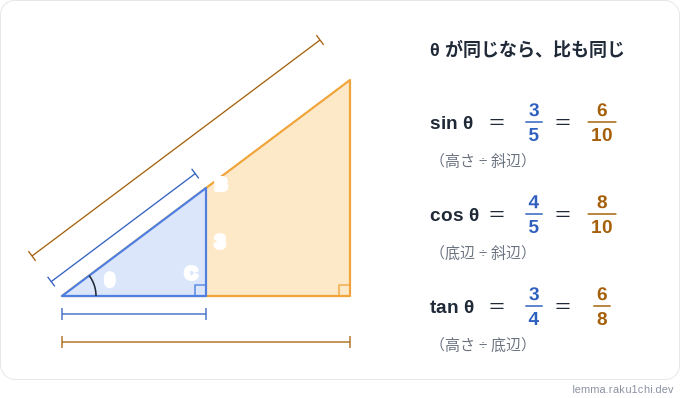
坂の急さを決めるのは、長さではなく比 です。道路の「勾配 10%」は水平に 100 m 進むと 10 m 上る坂で、50 m で 5 m 上る坂も同じ急さです。下の図の 2 つの直角三角形(3 辺が 3 , 4 , 5 3, 4, 5 3 , 4 , 5 θ \theta θ
定義 5.1 (三角比, trigonometric ratios)∠ C = 90 ∘ \angle \mathrm{C} = 90^\circ ∠ C = 9 0 ∘ ∠ A = θ \angle \mathrm{A} = \theta ∠ A = θ
sin θ = B C A B , \sin\theta = \frac{\mathrm{BC}}{\mathrm{AB}}, sin θ = AB BC , cos θ = A C A B , \cos\theta = \frac{\mathrm{AC}}{\mathrm{AB}}, cos θ = AB AC , tan θ = B C A C \tan\theta = \frac{\mathrm{BC}}{\mathrm{AC}} tan θ = AC BC をそれぞれ θ \theta θ 正弦 (サイン, sine)、余弦 (コサイン, cosine)、正接 (タンジェント, tangent)といい、まとめて三角比 といいます。
AB は斜辺、BC は角 θ \theta θ θ \theta θ sin θ \sin\theta sin θ sin \sin sin θ \theta θ θ \theta θ
直角と θ \theta θ P2 第6章 )、対応する辺の比は等しく、三角比は角 θ \theta θ です。
例 5.2 図の三角形では sin θ = 3 5 \displaystyle \sin\theta = \frac{3}{5} sin θ = 5 3 cos θ = 4 5 \displaystyle \cos\theta = \frac{4}{5} cos θ = 5 4 tan θ = 3 4 \displaystyle \tan\theta = \frac{3}{4} tan θ = 4 3 θ \theta θ 36.9 ∘ 36.9^\circ 36. 9 ∘ 6 10 \displaystyle \frac{6}{10} 10 6 8 10 \displaystyle \frac{8}{10} 10 8 6 8 \displaystyle \frac{6}{8} 8 6 θ \theta θ tan θ = 0.1 \tan\theta = 0.1 tan θ = 0.1 5.7 ∘ 5.7^\circ 5. 7 ∘
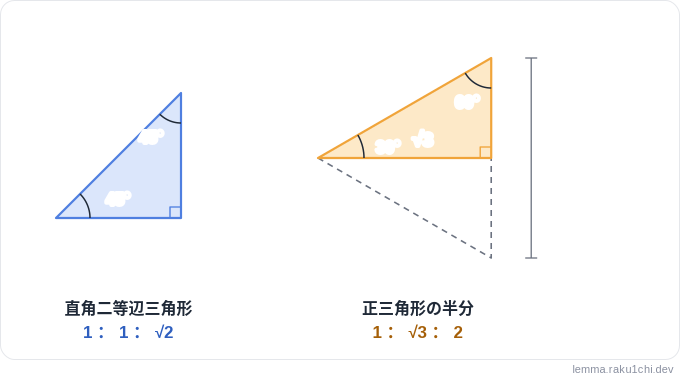
30°、45°、60° の この 3 つの角の値は、三角定規の形からわかります。直角二等辺三角形(角は 45 ∘ 45^\circ 4 5 ∘ 1 : 1 : 2 1 : 1 : \sqrt{2} 1 : 1 : 2 1 2 + 1 2 \sqrt{1^2 + 1^2} 1 2 + 1 2 30 ∘ 30^\circ 3 0 ∘ 60 ∘ 60^\circ 6 0 ∘ 90 ∘ 90^\circ 9 0 ∘ 30 ∘ 30^\circ 3 0 ∘ 1 1 1 2 2 2 2 2 − 1 2 = 3 \sqrt{2^2 - 1^2} = \sqrt{3} 2 2 − 1 2 = 3
θ \theta θ 30 ∘ 30^\circ 3 0 ∘ 45 ∘ 45^\circ 4 5 ∘ 60 ∘ 60^\circ 6 0 ∘
sin θ \sin\theta sin θ 1 2 \displaystyle \frac{1}{2} 2 1 1 2 \displaystyle \frac{1}{\sqrt{2}} 2 1 3 2 \displaystyle \frac{\sqrt{3}}{2} 2 3
cos θ \cos\theta cos θ 3 2 \displaystyle \frac{\sqrt{3}}{2} 2 3 1 2 \displaystyle \frac{1}{\sqrt{2}} 2 1 1 2 \displaystyle \frac{1}{2} 2 1
tan θ \tan\theta tan θ 1 3 \displaystyle \frac{1}{\sqrt{3}} 3 1 1 1 1 3 \sqrt{3} 3
ほかの角は関数電卓や表で調べます。木から 20 m 離れて、てっぺんを見上げる角(仰角 )が 35 ∘ 35^\circ 3 5 ∘ tan 35 ∘ = 0.7002 \tan 35^\circ = 0.7002 tan 3 5 ∘ = 0.7002 20 × 0.7002 ≈ 14.0 20 \times 0.7002 \approx 14.0 20 × 0.7002 ≈ 14.0
5.2 三 角比の補足
まず手を動かす
sin 30 ∘ \sin 30^\circ sin 3 0 ∘ cos 30 ∘ \cos 30^\circ cos 3 0 ∘ 45 ∘ 45^\circ 4 5 ∘
答え:1 4 + 3 4 = 1 \displaystyle \frac{1}{4} + \frac{3}{4} = 1 4 1 + 4 3 = 1 45 ∘ 45^\circ 4 5 ∘ 1 2 + 1 2 = 1 \displaystyle \frac{1}{2} + \frac{1}{2} = 1 2 1 + 2 1 = 1
相互関係
三角比は三角形の大きさによらないので、斜辺 AB を 1 にした直角三角形で考えると、高さ BC が sin θ \sin\theta sin θ cos θ \cos\theta cos θ です。三平方の定理から、次が成り立ちます。
性質 5.3 (三角比の相互関係)0 ∘ < θ < 90 ∘ 0^\circ < \theta < 90^\circ 0 ∘ < θ < 9 0 ∘
sin 2 θ + cos 2 θ = 1 , \sin^2\theta + \cos^2\theta = 1, sin 2 θ + cos 2 θ = 1 , tan θ = sin θ cos θ , \tan\theta = \frac{\sin\theta}{\cos\theta}, tan θ = cos θ sin θ , 1 + tan 2 θ = 1 cos 2 θ 1 + \tan^2\theta = \frac{1}{\cos^2\theta} 1 + tan 2 θ = cos 2 θ 1 です。また、sin ( 90 ∘ − θ ) = cos θ \sin(90^\circ - \theta) = \cos\theta sin ( 9 0 ∘ − θ ) = cos θ cos ( 90 ∘ − θ ) = sin θ \cos(90^\circ - \theta) = \sin\theta cos ( 9 0 ∘ − θ ) = sin θ
sin 2 θ \sin^2\theta sin 2 θ ( sin θ ) 2 (\sin\theta)^2 ( sin θ ) 2
証明. B C 2 + A C 2 = A B 2 \mathrm{BC}^2 + \mathrm{AC}^2 = \mathrm{AB}^2 BC 2 + AC 2 = AB 2 A B 2 \mathrm{AB}^2 AB 2 sin θ cos θ = B C A B ÷ A C A B = B C A C \displaystyle \frac{\sin\theta}{\cos\theta} = \frac{\mathrm{BC}}{\mathrm{AB}} \div \frac{\mathrm{AC}}{\mathrm{AB}} = \frac{\mathrm{BC}}{\mathrm{AC}} cos θ sin θ = AB BC ÷ AB AC = AC BC cos 2 θ \cos^2\theta cos 2 θ sin 2 θ cos 2 θ = tan 2 θ \displaystyle \frac{\sin^2\theta}{\cos^2\theta} = \tan^2\theta cos 2 θ sin 2 θ = tan 2 θ ∠ B = 90 ∘ − θ \angle \mathrm{B} = 90^\circ - \theta ∠ B = 9 0 ∘ − θ □ \square □
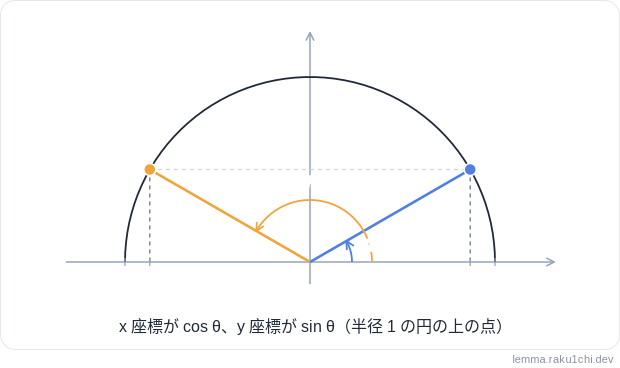
鈍角への 定義 5.1 は、120 ∘ 120^\circ 12 0 ∘ 単位円 , unit circle)の上半分に点 P をとり、x x x θ \theta θ θ \theta θ x x x cos θ = O H \cos\theta = \mathrm{OH} cos θ = OH x x x sin θ = H P \sin\theta = \mathrm{HP} sin θ = HP y y y
定義 5.4 (0 ∘ ≤ θ ≤ 180 ∘ 0^\circ \leq \theta \leq 180^\circ 0 ∘ ≤ θ ≤ 18 0 ∘ x x x θ \theta θ ( x , y ) (x, y) ( x , y ) cos θ = x \cos\theta = x cos θ = x sin θ = y \sin\theta = y sin θ = y tan θ = y x \displaystyle \tan\theta = \frac{y}{x} tan θ = x y θ ≠ 90 ∘ \theta \neq 90^\circ θ = 9 0 ∘
tan θ \tan\theta tan θ 定義 5.1 と同じ値です。
150 ∘ 150^\circ 15 0 ∘ 30 ∘ 30^\circ 3 0 ∘ y y y sin 150 ∘ = 1 2 \displaystyle \sin 150^\circ = \frac{1}{2} sin 15 0 ∘ = 2 1 cos 150 ∘ = − 3 2 \displaystyle \cos 150^\circ = -\frac{\sqrt{3}}{2} cos 15 0 ∘ = − 2 3 tan 150 ∘ = − 1 3 \displaystyle \tan 150^\circ = -\frac{1}{\sqrt{3}} tan 15 0 ∘ = − 3 1 sin 120 ∘ \sin 120^\circ sin 12 0 ∘ 120 ∘ 120^\circ 12 0 ∘ 3 2 \displaystyle \frac{\sqrt{3}}{2} 2 3
性質 5.5 (180 ∘ − θ 180^\circ - \theta 18 0 ∘ − θ 0 ∘ ≤ θ ≤ 180 ∘ 0^\circ \leq \theta \leq 180^\circ 0 ∘ ≤ θ ≤ 18 0 ∘ sin ( 180 ∘ − θ ) = sin θ \sin(180^\circ - \theta) = \sin\theta sin ( 18 0 ∘ − θ ) = sin θ cos ( 180 ∘ − θ ) = − cos θ \cos(180^\circ - \theta) = -\cos\theta cos ( 18 0 ∘ − θ ) = − cos θ tan ( 180 ∘ − θ ) = − tan θ \tan(180^\circ - \theta) = -\tan\theta tan ( 18 0 ∘ − θ ) = − tan θ θ ≠ 90 ∘ \theta \neq 90^\circ θ = 9 0 ∘
角 θ \theta θ 180 ∘ − θ 180^\circ - \theta 18 0 ∘ − θ y y y x 2 + y 2 = 1 x^2 + y^2 = 1 x 2 + y 2 = 1 P2 第7章 の公式 7.13 )。よって、性質 5.3 のはじめの 3 つの式は鈍角でも成り立ちます(tan θ \tan\theta tan θ θ ≠ 90 ∘ \theta \neq 90^\circ θ = 9 0 ∘ 1 2 b c sin A \displaystyle \frac{1}{2}bc\sin A 2 1 b c sin A b , c b, c b , c A A A P5 第1章 )。
5.3 一 般角と補足
まず手を動かす
時計の長針は、20 分で何度回りますか。1 時間 45 分ではどうですか。
答え:1 分で 6 ∘ 6^\circ 6 ∘ 120 ∘ 120^\circ 12 0 ∘ 630 ∘ 630^\circ 63 0 ∘
一般角
回転の量としての角は 360 ∘ 360^\circ 36 0 ∘ 動径 )を x x x 始線 )から回すと考え、反時計回りを正、時計回りを負として表した角を一般角 といいます。時計の針は時計回りなので、長針の 1 時間 45 分の回転は − 630 ∘ -630^\circ − 63 0 ∘
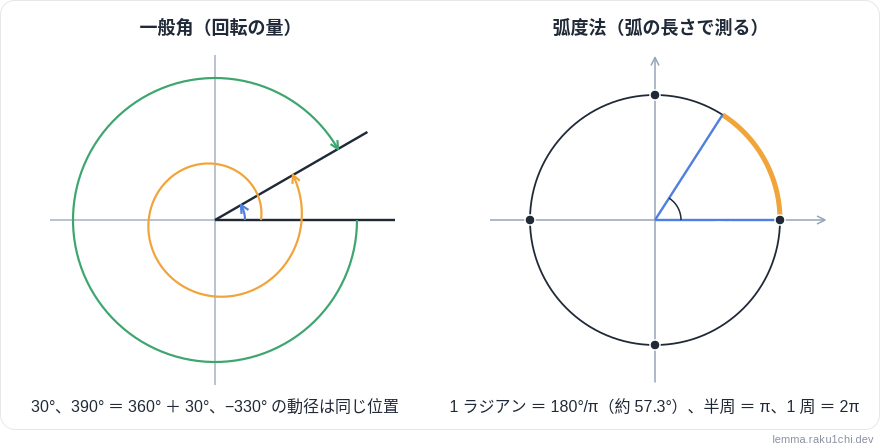
30 ∘ 30^\circ 3 0 ∘ 390 ∘ = 360 ∘ + 30 ∘ 390^\circ = 360^\circ + 30^\circ 39 0 ∘ = 36 0 ∘ + 3 0 ∘ − 330 ∘ = − 360 ∘ + 30 ∘ -330^\circ = -360^\circ + 30^\circ − 33 0 ∘ = − 36 0 ∘ + 3 0 ∘ θ \theta θ θ + 360 ∘ × n \theta + 360^\circ \times n θ + 36 0 ∘ × n n n n
弧度法
単位円の周の長さは 2 π 2\pi 2 π 180 ∘ 180^\circ 18 0 ∘ π \pi π 90 ∘ 90^\circ 9 0 ∘ π 2 \displaystyle \frac{\pi}{2} 2 π 単位円の弧の長さ で表します。
定義 5.6 (弧度法, radian measure)単位円で、長さ θ \theta θ θ \theta θ ラジアン (radian) といい、この角の測り方を弧度法 といいます。360 ∘ = 2 π 360^\circ = 2\pi 36 0 ∘ = 2 π
180 ∘ = π ラジアン , 180^\circ = \pi\ \text{ラジアン}, 18 0 ∘ = π ラジアン , 1 ∘ = π 180 ラジアン , 1^\circ = \frac{\pi}{180}\ \text{ラジアン}, 1 ∘ = 180 π ラジアン , 1 ラジアン = 180 ∘ π ≈ 57.3 ∘ 1\ \text{ラジアン} = \frac{180^\circ}{\pi} \approx 57.3^\circ 1 ラジアン = π 18 0 ∘ ≈ 57. 3 ∘ です。
ラジアンはふつう省略し、「θ = π 3 \displaystyle \theta = \frac{\pi}{3} θ = 3 π π 3 \displaystyle \frac{\pi}{3} 3 π 60 ∘ 60^\circ 6 0 ∘ 30 ∘ = π 6 \displaystyle 30^\circ = \frac{\pi}{6} 3 0 ∘ = 6 π 45 ∘ = π 4 \displaystyle 45^\circ = \frac{\pi}{4} 4 5 ∘ = 4 π 90 ∘ = π 2 \displaystyle 90^\circ = \frac{\pi}{2} 9 0 ∘ = 2 π 120 ∘ = 2 π 3 \displaystyle 120^\circ = \frac{2\pi}{3} 12 0 ∘ = 3 2 π 150 ∘ = 5 π 6 \displaystyle 150^\circ = \frac{5\pi}{6} 15 0 ∘ = 6 5 π 2 π 2\pi 2 π 2 π 2\pi 2 π 5.6 節の「この先の数学では」)。
性質 5.7 (扇形の弧の長さと面積)半径 r r r θ \theta θ l l l S S S l = r θ l = r\theta l = r θ S = 1 2 r 2 θ = 1 2 l r \displaystyle S = \frac{1}{2}r^2\theta = \frac{1}{2}lr S = 2 1 r 2 θ = 2 1 l r
証明. 扇形の弧の長さと面積は、中心角に比例します(中学校で学ぶ扇形の性質)。中心角 2 π 2\pi 2 π 2 π r 2\pi r 2 π r π r 2 \pi r^2 π r 2 θ \theta θ l = 2 π r × θ 2 π = r θ \displaystyle l = 2\pi r \times \frac{\theta}{2\pi} = r\theta l = 2 π r × 2 π θ = r θ S = π r 2 × θ 2 π = 1 2 r 2 θ \displaystyle S = \pi r^2 \times \frac{\theta}{2\pi} = \frac{1}{2}r^2\theta S = π r 2 × 2 π θ = 2 1 r 2 θ S = 1 2 ( r θ ) r \displaystyle S = \frac{1}{2}(r\theta)r S = 2 1 ( r θ ) r 1 2 l r \displaystyle \frac{1}{2}lr 2 1 l r □ \square □
度で書くと、弧の長さは 2 π r × 120 360 \displaystyle 2\pi r \times \frac{120}{360} 2 π r × 360 120 120 ∘ 120^\circ 12 0 ∘ r θ r\theta r θ
な 度は「1 周を 360 に分ける」という決めごとですが、ラジアンは「弧の長さ ÷ 半径」という長さどうしの比です。この違いは、小さな角で表に出ます。
θ \theta θ 0.5 0.5 0.5 0.1 0.1 0.1 0.01 0.01 0.01
sin θ \sin\theta sin θ 0.4794 0.4794 0.4794 0.09983 0.09983 0.09983 0.0099998 0.0099998 0.0099998
角が小さいほど、sin θ \sin\theta sin θ θ \theta θ sin θ θ \displaystyle \frac{\sin\theta}{\theta} θ sin θ 0.959 0.959 0.959 0.998 0.998 0.998 0.99998 0.99998 0.99998 sin θ \sin\theta sin θ θ \theta θ P4 第2章 で行います。
この「θ \theta θ sin θ ≈ θ \sin\theta \approx \theta sin θ ≈ θ x ∘ x^\circ x ∘ π 180 x \displaystyle \frac{\pi}{180}x 180 π x sin x ∘ ≈ π 180 x \displaystyle \sin x^\circ \approx \frac{\pi}{180}x sin x ∘ ≈ 180 π x π 180 = 0.01745 … \displaystyle \frac{\pi}{180} = 0.01745\ldots 180 π = 0.01745 …
補足
この先の数学では
「x x x sin x ≈ x \sin x \approx x sin x ≈ x y = sin x y = \sin x y = sin x y = x y = x y = x P4 第3章 微分法 では、h h h 0 0 0 sin h h \displaystyle \frac{\sin h}{h} h sin h 1 1 1 h h h ( sin x ) ′ = cos x (\sin x)' = \cos x ( sin x ) ′ = cos x π 180 \displaystyle \frac{\pi}{180} 180 π
5.4 単 位円で補足
まず手を動かす
(1) 210 ∘ 210^\circ 21 0 ∘ x x x 30 ∘ 30^\circ 3 0 ∘
答え:(1) 7 π 6 \displaystyle \frac{7\pi}{6} 6 7 π ( 3 2 , 1 2 ) \displaystyle \left(\frac{\sqrt{3}}{2},\ \frac{1}{2}\right) ( 2 3 , 2 1 )
5.2 節の「単位円の上の点の座標で読む」定義を、一般角と弧度法を使って、すべての実数の角に広げます。
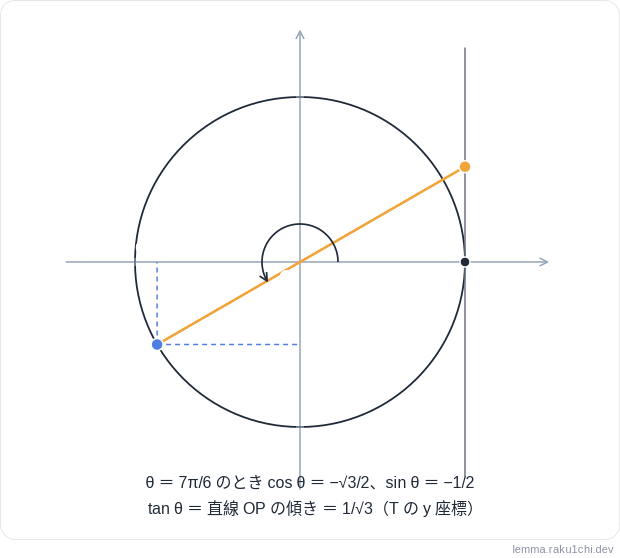
定義 5.8 (三角関数, trigonometric functions)θ \theta θ A ( 1 , 0 ) \mathrm{A}(1, 0) A ( 1 , 0 ) θ \theta θ P ( x , y ) \mathrm{P}(x, y) P ( x , y ) cos θ = x \cos\theta = x cos θ = x sin θ = y \sin\theta = y sin θ = y tan θ = y x \displaystyle \tan\theta = \frac{y}{x} tan θ = x y x ≠ 0 x \neq 0 x = 0 θ \theta θ 三角関数 といいます。
P は、A から単位円の上を、θ > 0 \theta > 0 θ > 0 θ < 0 \theta < 0 θ < 0 ∣ θ ∣ \lvert \theta \rvert ∣ θ ∣ 0 0 0 θ \theta θ tan θ \tan\theta tan θ x = 1 x = 1 x = 1 ( 1 , tan θ ) (1, \tan\theta) ( 1 , tan θ )
例 5.9 θ = 7 π 6 \displaystyle \theta = \frac{7\pi}{6} θ = 6 7 π 210 ∘ 210^\circ 21 0 ∘ π 6 \displaystyle \frac{\pi}{6} 6 π ( 3 2 , 1 2 ) \displaystyle \left(\frac{\sqrt{3}}{2},\ \frac{1}{2}\right) ( 2 3 , 2 1 ) ( − 3 2 , − 1 2 ) \displaystyle \left(-\frac{\sqrt{3}}{2},\ -\frac{1}{2}\right) ( − 2 3 , − 2 1 ) sin 7 π 6 = − 1 2 \displaystyle \sin\frac{7\pi}{6} = -\frac{1}{2} sin 6 7 π = − 2 1 cos 7 π 6 = − 3 2 \displaystyle \cos\frac{7\pi}{6} = -\frac{\sqrt{3}}{2} cos 6 7 π = − 2 3 tan 7 π 6 = ( − 1 2 ) ÷ ( − 3 2 ) = 1 3 \displaystyle \tan\frac{7\pi}{6} = \left(-\frac{1}{2}\right) \div \left(-\frac{\sqrt{3}}{2}\right) = \frac{1}{\sqrt{3}} tan 6 7 π = ( − 2 1 ) ÷ ( − 2 3 ) = 3 1
座標平面を軸で分けた 4 つの部分を、右上から反時計回りに第 1〜第 4 象限 といい、三角関数の符号は P のある象限で決まります(第 3 象限なら sin θ < 0 \sin\theta < 0 sin θ < 0 cos θ < 0 \cos\theta < 0 cos θ < 0 tan θ > 0 \tan\theta > 0 tan θ > 0 5.2 節と同じく x 2 + y 2 = 1 x^2 + y^2 = 1 x 2 + y 2 = 1 − 1 ≤ sin θ ≤ 1 -1 \leq \sin\theta \leq 1 − 1 ≤ sin θ ≤ 1 − 1 ≤ cos θ ≤ 1 -1 \leq \cos\theta \leq 1 − 1 ≤ cos θ ≤ 1 性質 5.3 のはじめの 3 つの式もそのまま成り立ちます(tan θ \tan\theta tan θ cos θ ≠ 0 \cos\theta \neq 0 cos θ = 0 r r r θ \theta θ r r r ( r cos θ , r sin θ ) (r\cos\theta, r\sin\theta) ( r cos θ , r sin θ )
性質 5.10 (三角関数の性質)すべての実数 θ \theta θ n n n tan \tan tan
sin ( θ + 2 n π ) = sin θ \sin(\theta + 2n\pi) = \sin\theta sin ( θ + 2 nπ ) = sin θ cos ( θ + 2 n π ) = cos θ \cos(\theta + 2n\pi) = \cos\theta cos ( θ + 2 nπ ) = cos θ sin ( − θ ) = − sin θ \sin(-\theta) = -\sin\theta sin ( − θ ) = − sin θ cos ( − θ ) = cos θ \cos(-\theta) = \cos\theta cos ( − θ ) = cos θ tan ( − θ ) = − tan θ \tan(-\theta) = -\tan\theta tan ( − θ ) = − tan θ sin ( θ + π ) = − sin θ \sin(\theta + \pi) = -\sin\theta sin ( θ + π ) = − sin θ cos ( θ + π ) = − cos θ \cos(\theta + \pi) = -\cos\theta cos ( θ + π ) = − cos θ tan ( θ + π ) = tan θ \tan(\theta + \pi) = \tan\theta tan ( θ + π ) = tan θ sin ( π − θ ) = sin θ \sin(\pi - \theta) = \sin\theta sin ( π − θ ) = sin θ cos ( π − θ ) = − cos θ \cos(\pi - \theta) = -\cos\theta cos ( π − θ ) = − cos θ
証明. P の座標を ( x , y ) (x, y) ( x , y ) 2 π 2\pi 2 π − θ -\theta − θ x x x ( x , − y ) (x, -y) ( x , − y ) π \pi π ( − x , − y ) (-x, -y) ( − x , − y ) π − θ = ( − θ ) + π \pi - \theta = (-\theta) + \pi π − θ = ( − θ ) + π sin ( π − θ ) = − sin ( − θ ) = sin θ \sin(\pi - \theta) = -\sin(-\theta) = \sin\theta sin ( π − θ ) = − sin ( − θ ) = sin θ cos ( π − θ ) = − cos ( − θ ) = − cos θ \cos(\pi - \theta) = -\cos(-\theta) = -\cos\theta cos ( π − θ ) = − cos ( − θ ) = − cos θ tan \tan tan y x \displaystyle \frac{y}{x} x y □ \square □
4 は性質 5.5 をすべての角に広げたものです。このほか sin ( θ + π 2 ) = cos θ \displaystyle \sin\left(\theta + \frac{\pi}{2}\right) = \cos\theta sin ( θ + 2 π ) = cos θ cos ( θ + π 2 ) = − sin θ \displaystyle \cos\left(\theta + \frac{\pi}{2}\right) = -\sin\theta cos ( θ + 2 π ) = − sin θ x x x y y y π 2 \displaystyle \frac{\pi}{2} 2 π 90 ∘ 90^\circ 9 0 ∘ θ + π 2 \displaystyle \theta + \frac{\pi}{2} θ + 2 π ( − y , x ) (-y, x) ( − y , x ) y y y x = cos θ x = \cos\theta x = cos θ x x x − y = − sin θ -y = -\sin\theta − y = − sin θ 5.6 節の加法定理からも導けます)。
5.5 三 角関数の補足
まず手を動かす
θ = 0 , π 2 , π , 3 π 2 , 2 π \displaystyle \theta = 0,\ \frac{\pi}{2},\ \pi,\ \frac{3\pi}{2},\ 2\pi θ = 0 , 2 π , π , 2 3 π , 2 π sin θ \sin\theta sin θ cos θ \cos\theta cos θ
答え:点は順に ( 1 , 0 ) (1, 0) ( 1 , 0 ) ( 0 , 1 ) (0, 1) ( 0 , 1 ) ( − 1 , 0 ) (-1, 0) ( − 1 , 0 ) ( 0 , − 1 ) (0, -1) ( 0 , − 1 ) ( 1 , 0 ) (1, 0) ( 1 , 0 ) sin θ \sin\theta sin θ 0 , 1 , 0 , − 1 , 0 0, 1, 0, -1, 0 0 , 1 , 0 , − 1 , 0 cos θ \cos\theta cos θ 1 , 0 , − 1 , 0 , 1 1, 0, -1, 0, 1 1 , 0 , − 1 , 0 , 1
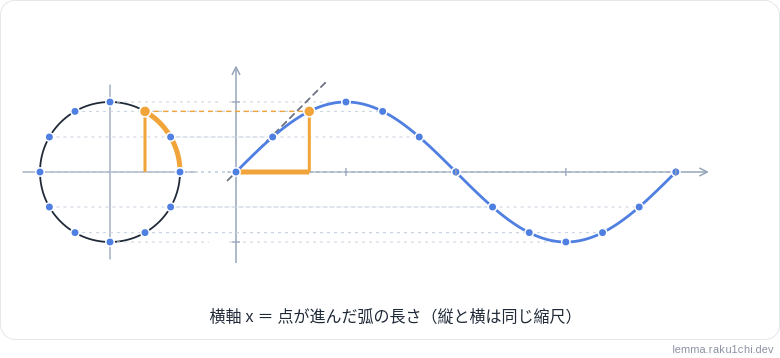
ここからは、ふつうの関数と同じく横軸を x x x y y y y = sin x y = \sin x y = sin x x x x x x x
弧度法では、横の x x x y y y 2 π ≈ 6.28 2\pi \approx 6.28 2 π ≈ 6.28 y = x y = x y = x 5.3 節の sin x ≈ x \sin x \approx x sin x ≈ x
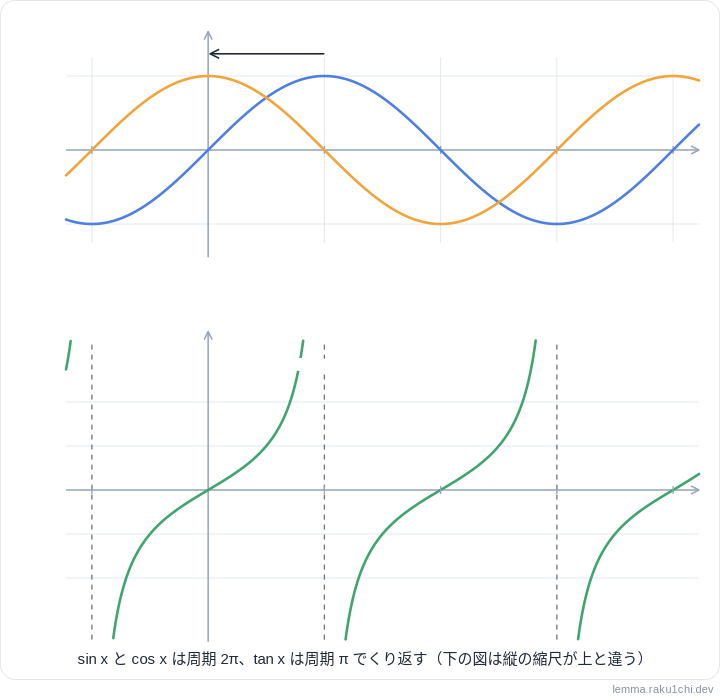
一般に、y = f ( x − p ) y = f(x - p) y = f ( x − p ) y = f ( x ) y = f(x) y = f ( x ) x x x p p p g ( x ) = f ( x − p ) g(x) = f(x - p) g ( x ) = f ( x − p ) g ( a + p ) = f ( a ) g(a + p) = f(a) g ( a + p ) = f ( a ) y = f ( x ) y = f(x) y = f ( x ) ( a , f ( a ) ) (a, f(a)) ( a , f ( a )) y = g ( x ) y = g(x) y = g ( x ) x x x p p p ( a + p , f ( a ) ) (a + p, f(a)) ( a + p , f ( a )) p < 0 p < 0 p < 0 5.4 節の cos x = sin ( x + π 2 ) \displaystyle \cos x = \sin\left(x + \frac{\pi}{2}\right) cos x = sin ( x + 2 π ) x + π 2 = x − ( − π 2 ) \displaystyle x + \frac{\pi}{2} = x - \left(-\frac{\pi}{2}\right) x + 2 π = x − ( − 2 π ) p = − π 2 \displaystyle p = -\frac{\pi}{2} p = − 2 π y = cos x y = \cos x y = cos x y = sin x y = \sin x y = sin x π 2 \displaystyle \frac{\pi}{2} 2 π y = tan x y = \tan x y = tan x cos x = 0 \cos x = 0 cos x = 0 x = π 2 + n π \displaystyle x = \frac{\pi}{2} + n\pi x = 2 π + nπ n n n 漸近線 )に限りなく近づきます。
定義 5.11 (周期, period)関数 f ( x ) f(x) f ( x ) 0 0 0 p p p x x x f ( x + p ) = f ( x ) f(x + p) = f(x) f ( x + p ) = f ( x ) f ( x ) f(x) f ( x ) 周期関数 、p p p 周期 といいます。ふつうは、正の周期のうち最小のものを、その関数の周期とよびます。
性質 5.10 の 1 と 3 から、sin x \sin x sin x cos x \cos x cos x 2 π 2\pi 2 π tan x \tan x tan x π \pi π sin x \sin x sin x p p p sin ( π 2 + p ) = sin π 2 = 1 \displaystyle \sin\left(\frac{\pi}{2} + p\right) = \sin\frac{\pi}{2} = 1 sin ( 2 π + p ) = sin 2 π = 1 sin x = 1 \sin x = 1 sin x = 1 x = π 2 + 2 n π \displaystyle x = \frac{\pi}{2} + 2n\pi x = 2 π + 2 nπ p ≥ 2 π p \geq 2\pi p ≥ 2 π cos \cos cos cos x = 1 \cos x = 1 cos x = 1 x = 2 n π x = 2n\pi x = 2 nπ tan \tan tan tan x = 0 \tan x = 0 tan x = 0 x = n π x = n\pi x = nπ 性質 5.10 の 2 から、y = cos x y = \cos x y = cos x y y y y = sin x y = \sin x y = sin x y = tan x y = \tan x y = tan x
y = 2 sin x y = 2\sin x y = 2 sin x − 2 -2 − 2 2 2 2 2 2 2 振幅 といいます。y = sin 2 x y = \sin 2x y = sin 2 x x x x 0 0 0 π \pi π 2 x 2x 2 x 0 0 0 2 π 2\pi 2 π π \pi π a > 0 a > 0 a > 0 b > 0 b > 0 b > 0 y = a sin b x y = a\sin bx y = a sin b x a a a 2 π b \displaystyle \frac{2\pi}{b} b 2 π
例 5.12 (家庭の交流の電圧)東日本のコンセントの電圧はおよそ v = 141 sin ( 100 π t ) v = 141\sin(100\pi t) v = 141 sin ( 100 π t ) t t t v v v 2 π 100 π = 1 50 \displaystyle \frac{2\pi}{100\pi} = \frac{1}{50} 100 π 2 π = 50 1
補足
この先の数学では
周期的に変わる量の多くは、周期の違う sin \sin sin cos \cos cos sin x + sin 3 x 3 + sin 5 x 5 + ⋯ \displaystyle \sin x + \frac{\sin 3x}{3} + \frac{\sin 5x}{5} + \cdots sin x + 3 sin 3 x + 5 sin 5 x + ⋯ 0 < x < π 0 < x < \pi 0 < x < π π 4 \displaystyle \frac{\pi}{4} 4 π − π < x < 0 -\pi < x < 0 − π < x < 0 − π 4 \displaystyle -\frac{\pi}{4} − 4 π フーリエ級数 (Fourier series) は、音や電気の信号を周波数ごとの成分に分けて調べる道具で、08 第6章 で扱います。
5.6 加 法定理補足
まず手を動かす
(1) 2 点 ( 1 , 2 ) (1, 2) ( 1 , 2 ) ( 4 , 6 ) (4, 6) ( 4 , 6 ) sin 90 ∘ \sin 90^\circ sin 9 0 ∘ sin 30 ∘ + sin 60 ∘ \sin 30^\circ + \sin 60^\circ sin 3 0 ∘ + sin 6 0 ∘
答え:(1) ( 4 − 1 ) 2 + ( 6 − 2 ) 2 = 25 = 5 \sqrt{(4 - 1)^2 + (6 - 2)^2} = \sqrt{25} = 5 ( 4 − 1 ) 2 + ( 6 − 2 ) 2 = 25 = 5 sin 90 ∘ = 1 \sin 90^\circ = 1 sin 9 0 ∘ = 1 sin 30 ∘ + sin 60 ∘ = 1 2 + 3 2 = 1.366 … \displaystyle \sin 30^\circ + \sin 60^\circ = \frac{1}{2} + \frac{\sqrt{3}}{2} = 1.366\ldots sin 3 0 ∘ + sin 6 0 ∘ = 2 1 + 2 3 = 1.366 …
注意
つまずきポイント
「まず手を動かす」の (2) のとおり、sin ( 30 ∘ + 60 ∘ ) \sin(30^\circ + 60^\circ) sin ( 3 0 ∘ + 6 0 ∘ ) sin 30 ∘ + sin 60 ∘ \sin 30^\circ + \sin 60^\circ sin 3 0 ∘ + sin 6 0 ∘ sin \sin sin sin 2 α \sin 2\alpha sin 2 α 2 sin α 2\sin\alpha 2 sin α
sin ( α + β ) \sin(\alpha + \beta) sin ( α + β )
定理 5.13 (加法定理, addition formulas)すべての実数 α , β \alpha, \beta α , β
sin ( α ± β ) = sin α cos β ± cos α sin β cos ( α ± β ) = cos α cos β ∓ sin α sin β \begin{aligned}
\sin(\alpha \pm \beta) &= \sin\alpha\cos\beta \pm \cos\alpha\sin\beta \\
\cos(\alpha \pm \beta) &= \cos\alpha\cos\beta \mp \sin\alpha\sin\beta
\end{aligned} sin ( α ± β ) cos ( α ± β ) = sin α cos β ± cos α sin β = cos α cos β ∓ sin α sin β が成り立ちます。また、cos α \cos\alpha cos α cos β \cos\beta cos β cos ( α + β ) \cos(\alpha + \beta) cos ( α + β ) 0 0 0 tan ( α + β ) = tan α + tan β 1 − tan α tan β \displaystyle \tan(\alpha + \beta) = \frac{\tan\alpha + \tan\beta}{1 - \tan\alpha\tan\beta} tan ( α + β ) = 1 − tan α tan β tan α + tan β
上の 2 行は、左辺が + + + − - − ± \pm ± ∓ \mp ∓
まず cos ( α − β ) \cos(\alpha - \beta) cos ( α − β )
2 点 ( x 1 , y 1 ) (x_1, y_1) ( x 1 , y 1 ) ( x 2 , y 2 ) (x_2, y_2) ( x 2 , y 2 ) d d d d 2 = ( x 2 − x 1 ) 2 + ( y 2 − y 1 ) 2 d^2 = (x_2 - x_1)^2 + (y_2 - y_1)^2 d 2 = ( x 2 − x 1 ) 2 + ( y 2 − y 1 ) 2 P2 第7章 )。
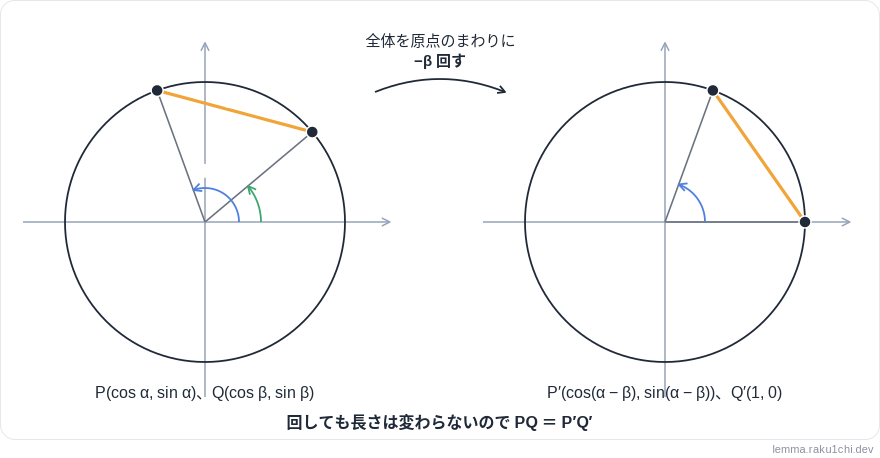
図形全体を原点のまわりに同じ角だけ回しても、2 点の距離は変わらない(回転移動の前後で図形は合同)。また、角 θ \theta θ φ \varphi φ θ + φ \theta + \varphi θ + φ
2 は中学校で学ぶ回転移動の性質と一般角の決め方で、ここでは図形の事実として認めます。2 の後半は「回す角は足し算になる」と言っているだけで、回した点の座標が cos \cos cos sin \sin sin
証明. 単位円の上に、角 α \alpha α P ( cos α , sin α ) \mathrm{P}(\cos\alpha, \sin\alpha) P ( cos α , sin α ) β \beta β Q ( cos β , sin β ) \mathrm{Q}(\cos\beta, \sin\beta) Q ( cos β , sin β ) sin 2 θ + cos 2 θ = 1 \sin^2\theta + \cos^2\theta = 1 sin 2 θ + cos 2 θ = 1
P Q 2 = ( cos α − cos β ) 2 + ( sin α − sin β ) 2 = cos 2 α − 2 cos α cos β + cos 2 β + sin 2 α − 2 sin α sin β + sin 2 β = ( cos 2 α + sin 2 α ) + ( cos 2 β + sin 2 β ) − 2 ( cos α cos β + sin α sin β ) = 2 − 2 ( cos α cos β + sin α sin β ) \begin{aligned}
\mathrm{PQ}^2 &= (\cos\alpha - \cos\beta)^2 + (\sin\alpha - \sin\beta)^2 \\
&= \cos^2\alpha - 2\cos\alpha\cos\beta + \cos^2\beta + \sin^2\alpha - 2\sin\alpha\sin\beta + \sin^2\beta \\
&= (\cos^2\alpha + \sin^2\alpha) + (\cos^2\beta + \sin^2\beta) - 2(\cos\alpha\cos\beta + \sin\alpha\sin\beta) \\
&= 2 - 2(\cos\alpha\cos\beta + \sin\alpha\sin\beta)
\end{aligned} PQ 2 = ( cos α − cos β ) 2 + ( sin α − sin β ) 2 = cos 2 α − 2 cos α cos β + cos 2 β + sin 2 α − 2 sin α sin β + sin 2 β = ( cos 2 α + sin 2 α ) + ( cos 2 β + sin 2 β ) − 2 ( cos α cos β + sin α sin β ) = 2 − 2 ( cos α cos β + sin α sin β ) です。次に、P と Q を原点のまわりに角 − β -\beta − β α − β \alpha - \beta α − β P ′ ( cos ( α − β ) , sin ( α − β ) ) \mathrm{P'}(\cos(\alpha - \beta), \sin(\alpha - \beta)) P ′ ( cos ( α − β ) , sin ( α − β )) 0 0 0 Q ′ ( 1 , 0 ) \mathrm{Q'}(1, 0) Q ′ ( 1 , 0 ) P ′ Q ′ = P Q \mathrm{P'Q'} = \mathrm{PQ} P ′ Q ′ = PQ
P ′ Q ′ 2 = { cos ( α − β ) − 1 } 2 + sin 2 ( α − β ) = cos 2 ( α − β ) − 2 cos ( α − β ) + 1 + sin 2 ( α − β ) = 2 − 2 cos ( α − β ) \begin{aligned}
\mathrm{P'Q'}^2 &= \lbrace \cos(\alpha - \beta) - 1 \rbrace^2 + \sin^2(\alpha - \beta) \\
&= \cos^2(\alpha - \beta) - 2\cos(\alpha - \beta) + 1 + \sin^2(\alpha - \beta) \\
&= 2 - 2\cos(\alpha - \beta)
\end{aligned} P ′ Q ′ 2 = { cos ( α − β ) − 1 } 2 + sin 2 ( α − β ) = cos 2 ( α − β ) − 2 cos ( α − β ) + 1 + sin 2 ( α − β ) = 2 − 2 cos ( α − β ) です。2 つの式は等しいので、両辺から 2 2 2 − 2 -2 − 2 cos ( α − β ) = cos α cos β + sin α sin β \cos(\alpha - \beta) = \cos\alpha\cos\beta + \sin\alpha\sin\beta cos ( α − β ) = cos α cos β + sin α sin β
この式で β \beta β − β -\beta − β 性質 5.10 の 2(cos ( − β ) = cos β \cos(-\beta) = \cos\beta cos ( − β ) = cos β sin ( − β ) = − sin β \sin(-\beta) = -\sin\beta sin ( − β ) = − sin β cos ( α + β ) = cos α cos β − sin α sin β \cos(\alpha + \beta) = \cos\alpha\cos\beta - \sin\alpha\sin\beta cos ( α + β ) = cos α cos β − sin α sin β α = π 2 \displaystyle \alpha = \frac{\pi}{2} α = 2 π cos π 2 = 0 \displaystyle \cos\frac{\pi}{2} = 0 cos 2 π = 0 sin π 2 = 1 \displaystyle \sin\frac{\pi}{2} = 1 sin 2 π = 1 cos ( π 2 − β ) = sin β \displaystyle \cos\left(\frac{\pi}{2} - \beta\right) = \sin\beta cos ( 2 π − β ) = sin β β \beta β π 2 − θ \displaystyle \frac{\pi}{2} - \theta 2 π − θ cos θ = sin ( π 2 − θ ) \displaystyle \cos\theta = \sin\left(\frac{\pi}{2} - \theta\right) cos θ = sin ( 2 π − θ )
sin ( α + β ) = cos ( π 2 − ( α + β ) ) = cos ( ( π 2 − α ) − β ) = cos ( π 2 − α ) cos β + sin ( π 2 − α ) sin β = sin α cos β + cos α sin β \begin{aligned}
\sin(\alpha + \beta) &= \cos\left(\frac{\pi}{2} - (\alpha + \beta)\right) = \cos\left(\left(\frac{\pi}{2} - \alpha\right) - \beta\right) \\
&= \cos\left(\frac{\pi}{2} - \alpha\right)\cos\beta + \sin\left(\frac{\pi}{2} - \alpha\right)\sin\beta \\
&= \sin\alpha\cos\beta + \cos\alpha\sin\beta
\end{aligned} sin ( α + β ) = cos ( 2 π − ( α + β ) ) = cos ( ( 2 π − α ) − β ) = cos ( 2 π − α ) cos β + sin ( 2 π − α ) sin β = sin α cos β + cos α sin β で、β \beta β − β -\beta − β sin ( α − β ) \sin(\alpha - \beta) sin ( α − β ) tan ( α + β ) = sin α cos β + cos α sin β cos α cos β − sin α sin β \displaystyle \tan(\alpha + \beta) = \frac{\sin\alpha\cos\beta + \cos\alpha\sin\beta}{\cos\alpha\cos\beta - \sin\alpha\sin\beta} tan ( α + β ) = cos α cos β − sin α sin β sin α cos β + cos α sin β cos α cos β \cos\alpha\cos\beta cos α cos β □ \square □
座標と距離だけで書けるので、α , β \alpha, \beta α , β
例 5.14 sin 75 ∘ = sin ( 45 ∘ + 30 ∘ ) = 1 2 ⋅ 3 2 + 1 2 ⋅ 1 2 = 3 + 1 2 2 = 6 + 2 4 \displaystyle \sin 75^\circ = \sin(45^\circ + 30^\circ) = \frac{1}{\sqrt{2}} \cdot \frac{\sqrt{3}}{2} + \frac{1}{\sqrt{2}} \cdot \frac{1}{2} = \frac{\sqrt{3} + 1}{2\sqrt{2}} = \frac{\sqrt{6} + \sqrt{2}}{4} sin 7 5 ∘ = sin ( 4 5 ∘ + 3 0 ∘ ) = 2 1 ⋅ 2 3 + 2 1 ⋅ 2 1 = 2 2 3 + 1 = 4 6 + 2 0.9659 0.9659 0.9659 2 \sqrt{2} 2
補足
この先の数学では
加法定理は「β \beta β α \alpha α α + β \alpha + \beta α + β P5 第6章 )のかけ算でもこの形で現れます。大学の微分積分(01 第6章 )では、sin x = x − x 3 6 + x 5 120 − ⋯ \displaystyle \sin x = x - \frac{x^3}{6} + \frac{x^5}{120} - \cdots sin x = x − 6 x 3 + 120 x 5 − ⋯ sin \sin sin cos \cos cos π \pi π cos x \cos x cos x 0 0 0 x x x
5.7 2 倍 角・半角の 補足
まず手を動かす
(1) 加法定理の sin ( α + β ) \sin(\alpha + \beta) sin ( α + β ) cos ( α + β ) \cos(\alpha + \beta) cos ( α + β ) β = α \beta = \alpha β = α ( 1 , 3 ) (1, \sqrt{3}) ( 1 , 3 )
答え:(1) sin 2 α = 2 sin α cos α \sin 2\alpha = 2\sin\alpha\cos\alpha sin 2 α = 2 sin α cos α cos 2 α = cos 2 α − sin 2 α \cos 2\alpha = \cos^2\alpha - \sin^2\alpha cos 2 α = cos 2 α − sin 2 α 1 + 3 = 2 \sqrt{1 + 3} = 2 1 + 3 = 2 π 3 \displaystyle \frac{\pi}{3} 3 π cos π 3 = 1 2 \displaystyle \cos\frac{\pi}{3} = \frac{1}{2} cos 3 π = 2 1 sin π 3 = 3 2 \displaystyle \sin\frac{\pi}{3} = \frac{\sqrt{3}}{2} sin 3 π = 2 3
2 倍 角の 「まず手を動かす」の (1) が 2 倍角の公式です。cos 2 α \cos 2\alpha cos 2 α sin 2 α = 1 − cos 2 α \sin^2\alpha = 1 - \cos^2\alpha sin 2 α = 1 − cos 2 α cos 2 α = 1 − sin 2 α \cos^2\alpha = 1 - \sin^2\alpha cos 2 α = 1 − sin 2 α
公式 5.15 (2 倍角の公式)すべての実数 α \alpha α
sin 2 α = 2 sin α cos α , \sin 2\alpha = 2\sin\alpha\cos\alpha, sin 2 α = 2 sin α cos α , cos 2 α = cos 2 α − sin 2 α = 2 cos 2 α − 1 = 1 − 2 sin 2 α \cos 2\alpha = \cos^2\alpha - \sin^2\alpha = 2\cos^2\alpha - 1 = 1 - 2\sin^2\alpha cos 2 α = cos 2 α − sin 2 α = 2 cos 2 α − 1 = 1 − 2 sin 2 α です。cos α ≠ 0 \cos\alpha \neq 0 cos α = 0 cos 2 α ≠ 0 \cos 2\alpha \neq 0 cos 2 α = 0 tan 2 α = 2 tan α 1 − tan 2 α \displaystyle \tan 2\alpha = \frac{2\tan\alpha}{1 - \tan^2\alpha} tan 2 α = 1 − tan 2 α 2 tan α tan \tan tan β = α \beta = \alpha β = α
cos 2 θ = 1 − 2 sin 2 θ \cos 2\theta = 1 - 2\sin^2\theta cos 2 θ = 1 − 2 sin 2 θ sin 2 θ \sin^2\theta sin 2 θ sin 2 θ = 1 − cos 2 θ 2 \displaystyle \sin^2\theta = \frac{1 - \cos 2\theta}{2} sin 2 θ = 2 1 − cos 2 θ θ = α 2 \displaystyle \theta = \frac{\alpha}{2} θ = 2 α cos 2 θ = 2 cos 2 θ − 1 \cos 2\theta = 2\cos^2\theta - 1 cos 2 θ = 2 cos 2 θ − 1
公式 5.16 (半角の公式)すべての実数 α \alpha α
sin 2 α 2 = 1 − cos α 2 , \sin^2\frac{\alpha}{2} = \frac{1 - \cos\alpha}{2}, sin 2 2 α = 2 1 − cos α , cos 2 α 2 = 1 + cos α 2 \cos^2\frac{\alpha}{2} = \frac{1 + \cos\alpha}{2} cos 2 2 α = 2 1 + cos α です。cos α ≠ − 1 \cos\alpha \neq -1 cos α = − 1 tan 2 α 2 = 1 − cos α 1 + cos α \displaystyle \tan^2\frac{\alpha}{2} = \frac{1 - \cos\alpha}{1 + \cos\alpha} tan 2 2 α = 1 + cos α 1 − cos α
半角の公式は、sin 2 x = 1 − cos 2 x 2 \displaystyle \sin^2 x = \frac{1 - \cos 2x}{2} sin 2 x = 2 1 − cos 2 x P4 )でも使います。
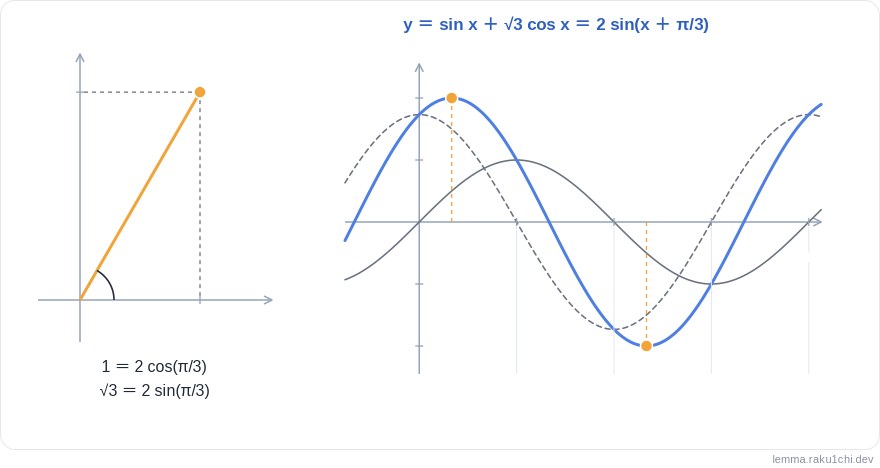
三角関数の y = sin x + 3 cos x y = \sin x + \sqrt{3}\cos x y = sin x + 3 cos x sin x = 1 \sin x = 1 sin x = 1 x = π 2 \displaystyle x = \frac{\pi}{2} x = 2 π cos x = 0 \cos x = 0 cos x = 0 1 + 3 1 + \sqrt{3} 1 + 3 1 = 2 cos π 3 \displaystyle 1 = 2\cos\frac{\pi}{3} 1 = 2 cos 3 π 3 = 2 sin π 3 \displaystyle \sqrt{3} = 2\sin\frac{\pi}{3} 3 = 2 sin 3 π
sin x + 3 cos x = 2 ( sin x cos π 3 + cos x sin π 3 ) = 2 sin ( x + π 3 ) \begin{aligned}
\sin x + \sqrt{3}\cos x &= 2\left(\sin x\cos\frac{\pi}{3} + \cos x\sin\frac{\pi}{3}\right) \\
&= 2\sin\left(x + \frac{\pi}{3}\right)
\end{aligned} sin x + 3 cos x = 2 ( sin x cos 3 π + cos x sin 3 π ) = 2 sin ( x + 3 π ) です(加法定理を右から左へ使いました)。− 1 ≤ sin ( x + π 3 ) ≤ 1 \displaystyle -1 \leq \sin\left(x + \frac{\pi}{3}\right) \leq 1 − 1 ≤ sin ( x + 3 π ) ≤ 1 2 2 2 x + π 3 = π 2 \displaystyle x + \frac{\pi}{3} = \frac{\pi}{2} x + 3 π = 2 π x = π 6 \displaystyle x = \frac{\pi}{6} x = 6 π − 2 -2 − 2
公式 5.17 (三角関数の合成)実数 a , b a, b a , b ( a , b ) ≠ ( 0 , 0 ) (a, b) \neq (0, 0) ( a , b ) = ( 0 , 0 ) r = a 2 + b 2 r = \sqrt{a^2 + b^2} r = a 2 + b 2 ( a , b ) (a, b) ( a , b ) α \alpha α cos α = a r \displaystyle \cos\alpha = \frac{a}{r} cos α = r a sin α = b r \displaystyle \sin\alpha = \frac{b}{r} sin α = r b x x x a sin x + b cos x = r sin ( x + α ) a\sin x + b\cos x = r\sin(x + \alpha) a sin x + b cos x = r sin ( x + α )
証明. 5.4 節より a = r cos α a = r\cos\alpha a = r cos α b = r sin α b = r\sin\alpha b = r sin α a sin x + b cos x = r ( sin x cos α + cos x sin α ) = r sin ( x + α ) a\sin x + b\cos x = r(\sin x\cos\alpha + \cos x\sin\alpha) = r\sin(x + \alpha) a sin x + b cos x = r ( sin x cos α + cos x sin α ) = r sin ( x + α ) □ \square □
a sin x + b cos x a\sin x + b\cos x a sin x + b cos x a 2 + b 2 \sqrt{a^2 + b^2} a 2 + b 2 − a 2 + b 2 -\sqrt{a^2 + b^2} − a 2 + b 2 sin \sin sin cos \cos cos
5.8 三 角方程式と補足
まず手を動かす
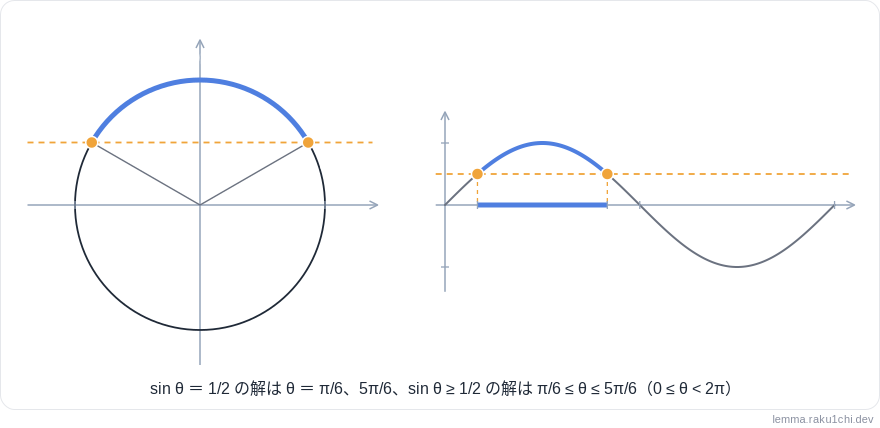
単位円の上で y y y 1 2 \displaystyle \frac{1}{2} 2 1 0 0 0 2 π 2\pi 2 π
答え:( 3 2 , 1 2 ) \displaystyle \left(\frac{\sqrt{3}}{2},\ \frac{1}{2}\right) ( 2 3 , 2 1 ) ( − 3 2 , 1 2 ) \displaystyle \left(-\frac{\sqrt{3}}{2},\ \frac{1}{2}\right) ( − 2 3 , 2 1 ) π 6 \displaystyle \frac{\pi}{6} 6 π 5 π 6 \displaystyle \frac{5\pi}{6} 6 5 π
三角関数を含む方程式・不等式は、「単位円の上のどの点か」に言いかえて解きます。
例 5.18 0 ≤ θ < 2 π 0 \leq \theta < 2\pi 0 ≤ θ < 2 π sin θ = 1 2 \displaystyle \sin\theta = \frac{1}{2} sin θ = 2 1 y = 1 2 \displaystyle y = \frac{1}{2} y = 2 1 θ = π 6 , 5 π 6 \displaystyle \theta = \frac{\pi}{6},\ \frac{5\pi}{6} θ = 6 π , 6 5 π θ = π 6 + 2 n π , 5 π 6 + 2 n π \displaystyle \theta = \frac{\pi}{6} + 2n\pi,\ \frac{5\pi}{6} + 2n\pi θ = 6 π + 2 nπ , 6 5 π + 2 nπ n n n tan θ = − 1 \tan\theta = -1 tan θ = − 1 − 1 -1 − 1 y = − x y = -x y = − x θ = 3 π 4 , 7 π 4 \displaystyle \theta = \frac{3\pi}{4},\ \frac{7\pi}{4} θ = 4 3 π , 4 7 π
例 5.19 0 ≤ θ < 2 π 0 \leq \theta < 2\pi 0 ≤ θ < 2 π sin θ ≥ 1 2 \displaystyle \sin\theta \geq \frac{1}{2} sin θ ≥ 2 1 1 2 \displaystyle \frac{1}{2} 2 1 π 6 ≤ θ ≤ 5 π 6 \displaystyle \frac{\pi}{6} \leq \theta \leq \frac{5\pi}{6} 6 π ≤ θ ≤ 6 5 π
例 5.20 (合成を使う)0 ≤ x < 2 π 0 \leq x < 2\pi 0 ≤ x < 2 π 3 sin x + cos x = 1 \sqrt{3}\sin x + \cos x = 1 3 sin x + cos x = 1 ( 3 , 1 ) (\sqrt{3}, 1) ( 3 , 1 ) π 6 \displaystyle \frac{\pi}{6} 6 π 公式 5.17 より方程式は 2 sin ( x + π 6 ) = 1 \displaystyle 2\sin\left(x + \frac{\pi}{6}\right) = 1 2 sin ( x + 6 π ) = 1 sin ( x + π 6 ) = 1 2 \displaystyle \sin\left(x + \frac{\pi}{6}\right) = \frac{1}{2} sin ( x + 6 π ) = 2 1 t = x + π 6 \displaystyle t = x + \frac{\pi}{6} t = x + 6 π t t t π 6 ≤ t < 13 π 6 \displaystyle \frac{\pi}{6} \leq t < \frac{13\pi}{6} 6 π ≤ t < 6 13 π sin t = 1 2 \displaystyle \sin t = \frac{1}{2} sin t = 2 1 t = π 6 , 5 π 6 \displaystyle t = \frac{\pi}{6},\ \frac{5\pi}{6} t = 6 π , 6 5 π 13 π 6 \displaystyle \frac{13\pi}{6} 6 13 π x = 0 , 2 π 3 \displaystyle x = 0,\ \frac{2\pi}{3} x = 0 , 3 2 π
sin θ \sin\theta sin θ sin θ = s \sin\theta = s sin θ = s P2 第4章 )、− 1 ≤ s ≤ 1 -1 \leq s \leq 1 − 1 ≤ s ≤ 1 θ \theta θ
注意
つまずきポイント
置きかえた変数の範囲を確かめないと、解を落とします。0 ≤ x < 2 π 0 \leq x < 2\pi 0 ≤ x < 2 π sin 2 x = 1 2 \displaystyle \sin 2x = \frac{1}{2} sin 2 x = 2 1 t = 2 x t = 2x t = 2 x 0 ≤ t < 4 π 0 \leq t < 4\pi 0 ≤ t < 4 π sin t = 1 2 \displaystyle \sin t = \frac{1}{2} sin t = 2 1 t = π 6 , 5 π 6 \displaystyle t = \frac{\pi}{6},\ \frac{5\pi}{6} t = 6 π , 6 5 π t = 13 π 6 , 17 π 6 \displaystyle t = \frac{13\pi}{6},\ \frac{17\pi}{6} t = 6 13 π , 6 17 π x = π 12 , 5 π 12 , 13 π 12 , 17 π 12 \displaystyle x = \frac{\pi}{12},\ \frac{5\pi}{12},\ \frac{13\pi}{12},\ \frac{17\pi}{12} x = 12 π , 12 5 π , 12 13 π , 12 17 π
まとめ
三角比 sin θ \sin\theta sin θ cos θ \cos\theta cos θ tan θ \tan\theta tan θ θ \theta θ P ( cos θ , sin θ ) \mathrm{P}(\cos\theta, \sin\theta) P ( cos θ , sin θ ) tan θ \tan\theta tan θ
三平方の定理から sin 2 θ + cos 2 θ = 1 \sin^2\theta + \cos^2\theta = 1 sin 2 θ + cos 2 θ = 1
弧度法は角を単位円の弧の長さで測り、180 ∘ = π 180^\circ = \pi 18 0 ∘ = π r θ r\theta r θ 1 2 r 2 θ \displaystyle \frac{1}{2}r^2\theta 2 1 r 2 θ sin θ ≈ θ \sin\theta \approx \theta sin θ ≈ θ
sin x \sin x sin x cos x \cos x cos x 2 π 2\pi 2 π tan x \tan x tan x π \pi π y = a sin b x y = a\sin bx y = a sin b x a a a 2 π b \displaystyle \frac{2\pi}{b} b 2 π 加法定理は、単位円の上の 2 点の距離を原点のまわりに回す前と後で比べて証明でき、そこから 2 倍角・半角の公式、合成 a sin x + b cos x = a 2 + b 2 sin ( x + α ) a\sin x + b\cos x = \sqrt{a^2 + b^2}\sin(x + \alpha) a sin x + b cos x = a 2 + b 2 sin ( x + α )
三角方程式・三角不等式は、単位円の上の点やグラフに言いかえて解きます。置きかえた変数の範囲に注意します。
演習問題
問題 5.1 ★ (1) sin 135 ∘ \sin 135^\circ sin 13 5 ∘ cos 135 ∘ \cos 135^\circ cos 13 5 ∘ tan 135 ∘ \tan 135^\circ tan 13 5 ∘ 2 π 3 \displaystyle \frac{2\pi}{3} 3 2 π
解答
(1) 性質 5.5 で θ = 45 ∘ \theta = 45^\circ θ = 4 5 ∘ sin 135 ∘ = sin 45 ∘ = 1 2 \displaystyle \sin 135^\circ = \sin 45^\circ = \frac{1}{\sqrt{2}} sin 13 5 ∘ = sin 4 5 ∘ = 2 1 cos 135 ∘ = − cos 45 ∘ = − 1 2 \displaystyle \cos 135^\circ = -\cos 45^\circ = -\frac{1}{\sqrt{2}} cos 13 5 ∘ = − cos 4 5 ∘ = − 2 1 tan 135 ∘ = − tan 45 ∘ = − 1 \tan 135^\circ = -\tan 45^\circ = -1 tan 13 5 ∘ = − tan 4 5 ∘ = − 1
(2) 性質 5.7 より、弧の長さは 6 × 2 π 3 = 4 π \displaystyle 6 \times \frac{2\pi}{3} = 4\pi 6 × 3 2 π = 4 π 1 2 × 6 2 × 2 π 3 = 12 π \displaystyle \frac{1}{2} \times 6^2 \times \frac{2\pi}{3} = 12\pi 2 1 × 6 2 × 3 2 π = 12 π
問題 5.2 ★★ 【説明】 高校生の子に「角度は 360° のままでいいのに、なんで π とかラジアンを使うの?」と聞かれました。理由を 2 つ以上挙げて、子どもに話す言葉で説明してください。
ヒント 1
ラジアンが「何と何の比」だったかを思い出し、5.3 節で度との違いが表に出た場面を探してください。
ヒント 2
1 つめの理由の手がかりに、中心角 120 ∘ 120^\circ 12 0 ∘
解答
説明の例:「度は『1 周を 360 に分ける』という決めごとだけど、ラジアンは『弧の長さ ÷ 半径』で、長さだけで決まる測り方なんだ。1 つめの理由は、式が簡単になること。扇形の弧の長さは、度だと 2 π r × 120 360 \displaystyle 2\pi r \times \frac{120}{360} 2 π r × 360 120 r θ r\theta r θ sin θ \sin\theta sin θ θ \theta θ sin 0.01 = 0.0099998 … \sin 0.01 = 0.0099998\ldots sin 0.01 = 0.0099998 … sin 1 ∘ = 0.01745 … \sin 1^\circ = 0.01745\ldots sin 1 ∘ = 0.01745 … π 180 \displaystyle \frac{\pi}{180} 180 π sin x \sin x sin x cos x \cos x cos x P4 第3章 。)
解けた ヒントで まだ AI で AI で
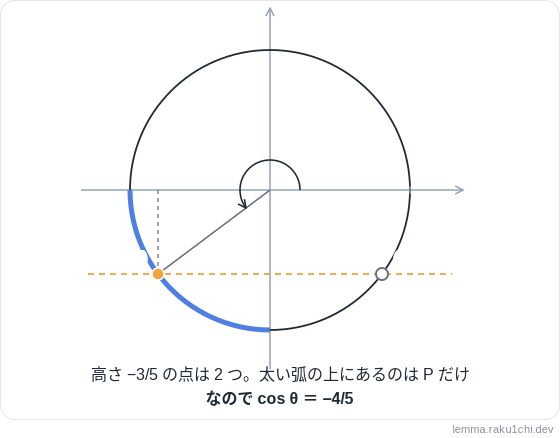
問題 5.3 ★ π < θ < 3 π 2 \displaystyle \pi < \theta < \frac{3\pi}{2} π < θ < 2 3 π sin θ = − 3 5 \displaystyle \sin\theta = -\frac{3}{5} sin θ = − 5 3 cos θ \cos\theta cos θ tan θ \tan\theta tan θ
解答
sin 2 θ + cos 2 θ = 1 \sin^2\theta + \cos^2\theta = 1 sin 2 θ + cos 2 θ = 1 cos 2 θ = 1 − 9 25 = 16 25 \displaystyle \cos^2\theta = 1 - \frac{9}{25} = \frac{16}{25} cos 2 θ = 1 − 25 9 = 25 16 π < θ < 3 π 2 \displaystyle \pi < \theta < \frac{3\pi}{2} π < θ < 2 3 π cos θ < 0 \cos\theta < 0 cos θ < 0 cos θ = − 4 5 \displaystyle \cos\theta = -\frac{4}{5} cos θ = − 5 4 tan θ = ( − 3 5 ) ÷ ( − 4 5 ) = 3 4 \displaystyle \tan\theta = \left(-\frac{3}{5}\right) \div \left(-\frac{4}{5}\right) = \frac{3}{4} tan θ = ( − 5 3 ) ÷ ( − 5 4 ) = 4 3 − 3 5 \displaystyle -\frac{3}{5} − 5 3 π < θ < 3 π 2 \displaystyle \pi < \theta < \frac{3\pi}{2} π < θ < 2 3 π
問題 5.4 ★ 【穴埋め】 加法定理の cos ( α − β ) \cos(\alpha - \beta) cos ( α − β )
単位円の上に、角 α \alpha α P ( cos α , sin α ) \mathrm{P}(\cos\alpha, \sin\alpha) P ( cos α , sin α ) β \beta β Q ( cos β , sin β ) \mathrm{Q}(\cos\beta, \sin\beta) Q ( cos β , sin β ) P Q 2 = (ア) \mathrm{PQ}^2 = \text{(ア)} PQ 2 = (ア) sin 2 θ + cos 2 θ = 1 \sin^2\theta + \cos^2\theta = 1 sin 2 θ + cos 2 θ = 1 P Q 2 = 2 − 2 ( cos α cos β + sin α sin β ) \mathrm{PQ}^2 = 2 - 2(\cos\alpha\cos\beta + \sin\alpha\sin\beta) PQ 2 = 2 − 2 ( cos α cos β + sin α sin β ) α − β \alpha - \beta α − β Q ′ ( 1 , 0 ) \mathrm{Q'}(1, 0) Q ′ ( 1 , 0 ) P Q 2 = P ′ Q ′ 2 = (ウ) = (エ) \mathrm{PQ}^2 = \mathrm{P'Q'}^2 = \text{(ウ)} = \text{(エ)} PQ 2 = P ′ Q ′ 2 = (ウ) = (エ) cos ( α − β ) = cos α cos β + sin α sin β \cos(\alpha - \beta) = \cos\alpha\cos\beta + \sin\alpha\sin\beta cos ( α − β ) = cos α cos β + sin α sin β
解答
(ア)( cos α − cos β ) 2 + ( sin α − sin β ) 2 (\cos\alpha - \cos\beta)^2 + (\sin\alpha - \sin\beta)^2 ( cos α − cos β ) 2 + ( sin α − sin β ) 2 − β -\beta − β { cos ( α − β ) − 1 } 2 + sin 2 ( α − β ) \lbrace \cos(\alpha - \beta) - 1 \rbrace^2 + \sin^2(\alpha - \beta) { cos ( α − β ) − 1 } 2 + sin 2 ( α − β ) 2 − 2 cos ( α − β ) 2 - 2\cos(\alpha - \beta) 2 − 2 cos ( α − β )
埋めたあとの証明:単位円の上に、角 α \alpha α P ( cos α , sin α ) \mathrm{P}(\cos\alpha, \sin\alpha) P ( cos α , sin α ) β \beta β Q ( cos β , sin β ) \mathrm{Q}(\cos\beta, \sin\beta) Q ( cos β , sin β ) P Q 2 = ( cos α − cos β ) 2 + ( sin α − sin β ) 2 \mathrm{PQ}^2 = (\cos\alpha - \cos\beta)^2 + (\sin\alpha - \sin\beta)^2 PQ 2 = ( cos α − cos β ) 2 + ( sin α − sin β ) 2 sin 2 θ + cos 2 θ = 1 \sin^2\theta + \cos^2\theta = 1 sin 2 θ + cos 2 θ = 1 P Q 2 = 2 − 2 ( cos α cos β + sin α sin β ) \mathrm{PQ}^2 = 2 - 2(\cos\alpha\cos\beta + \sin\alpha\sin\beta) PQ 2 = 2 − 2 ( cos α cos β + sin α sin β ) − β -\beta − β α − β \alpha - \beta α − β Q ′ ( 1 , 0 ) \mathrm{Q'}(1, 0) Q ′ ( 1 , 0 ) P Q 2 = P ′ Q ′ 2 = { cos ( α − β ) − 1 } 2 + sin 2 ( α − β ) = 2 − 2 cos ( α − β ) \mathrm{PQ}^2 = \mathrm{P'Q'}^2 = \lbrace \cos(\alpha - \beta) - 1 \rbrace^2 + \sin^2(\alpha - \beta) = 2 - 2\cos(\alpha - \beta) PQ 2 = P ′ Q ′ 2 = { cos ( α − β ) − 1 } 2 + sin 2 ( α − β ) = 2 − 2 cos ( α − β ) cos ( α − β ) = cos α cos β + sin α sin β \cos(\alpha - \beta) = \cos\alpha\cos\beta + \sin\alpha\sin\beta cos ( α − β ) = cos α cos β + sin α sin β □ \square □
P、Q と、回したあとの P′、Q′ の位置は、5.6 節の図のとおりです。
解けた ヒントで まだ AI で AI で
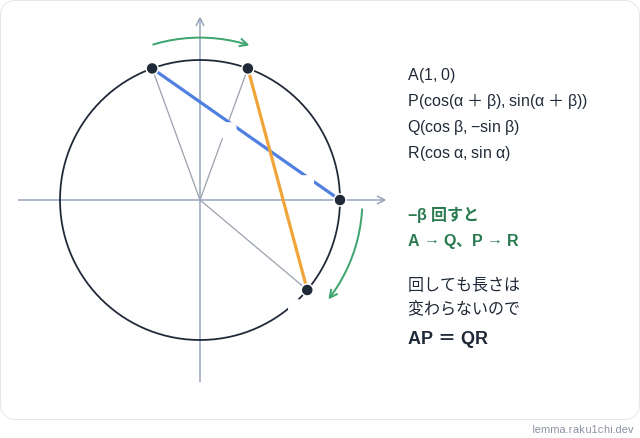
問題 5.5 ★★ 問題 5.4 と同じ方法で、cos ( α + β ) = cos α cos β − sin α sin β \cos(\alpha + \beta) = \cos\alpha\cos\beta - \sin\alpha\sin\beta cos ( α + β ) = cos α cos β − sin α sin β A ( 1 , 0 ) \mathrm{A}(1, 0) A ( 1 , 0 ) α + β \alpha + \beta α + β − β -\beta − β α \alpha α
ヒント 1
問題 5.4 と同じく、2 点の組を原点のまわりに回して、もう 1 組の 2 点に重ね、距離が等しいことを使います。
ヒント 2
A を Q に重ねるには、原点のまわりに何だけ回せばよいでしょうか。A と P を一緒にその角だけ回すと、P がどこへ移るかを見ます。
解答
各点の座標は A ( 1 , 0 ) \mathrm{A}(1, 0) A ( 1 , 0 ) P ( cos ( α + β ) , sin ( α + β ) ) \mathrm{P}(\cos(\alpha + \beta), \sin(\alpha + \beta)) P ( cos ( α + β ) , sin ( α + β )) Q ( cos β , − sin β ) \mathrm{Q}(\cos\beta, -\sin\beta) Q ( cos β , − sin β ) 性質 5.10 の 2)、R ( cos α , sin α ) \mathrm{R}(\cos\alpha, \sin\alpha) R ( cos α , sin α ) − β -\beta − β − β -\beta − β α \alpha α A P = Q R \mathrm{AP} = \mathrm{QR} AP = QR
距離の公式と sin 2 θ + cos 2 θ = 1 \sin^2\theta + \cos^2\theta = 1 sin 2 θ + cos 2 θ = 1
A P 2 = { cos ( α + β ) − 1 } 2 + sin 2 ( α + β ) = 2 − 2 cos ( α + β ) Q R 2 = ( cos α − cos β ) 2 + ( sin α + sin β ) 2 = cos 2 α − 2 cos α cos β + cos 2 β + sin 2 α + 2 sin α sin β + sin 2 β = 2 − 2 ( cos α cos β − sin α sin β ) \begin{aligned}
\mathrm{AP}^2 &= \lbrace \cos(\alpha + \beta) - 1 \rbrace^2 + \sin^2(\alpha + \beta) = 2 - 2\cos(\alpha + \beta) \\
\mathrm{QR}^2 &= (\cos\alpha - \cos\beta)^2 + (\sin\alpha + \sin\beta)^2 \\
&= \cos^2\alpha - 2\cos\alpha\cos\beta + \cos^2\beta + \sin^2\alpha + 2\sin\alpha\sin\beta + \sin^2\beta \\
&= 2 - 2(\cos\alpha\cos\beta - \sin\alpha\sin\beta)
\end{aligned} AP 2 QR 2 = { cos ( α + β ) − 1 } 2 + sin 2 ( α + β ) = 2 − 2 cos ( α + β ) = ( cos α − cos β ) 2 + ( sin α + sin β ) 2 = cos 2 α − 2 cos α cos β + cos 2 β + sin 2 α + 2 sin α sin β + sin 2 β = 2 − 2 ( cos α cos β − sin α sin β ) です(A P 2 \mathrm{AP}^2 AP 2 5.6 節の P ′ Q ′ 2 \mathrm{P'Q'}^2 P ′ Q ′ 2 A P 2 = Q R 2 \mathrm{AP}^2 = \mathrm{QR}^2 AP 2 = QR 2 − 2 -2 − 2 cos ( α + β ) = cos α cos β − sin α sin β \cos(\alpha + \beta) = \cos\alpha\cos\beta - \sin\alpha\sin\beta cos ( α + β ) = cos α cos β − sin α sin β □ \square □
解けた ヒントで まだ AI で AI で
問題 5.6 ★★ (1) π 2 < α < π \displaystyle \frac{\pi}{2} < \alpha < \pi 2 π < α < π sin α = 3 5 \displaystyle \sin\alpha = \frac{3}{5} sin α = 5 3 sin 2 α \sin 2\alpha sin 2 α cos 2 α \cos 2\alpha cos 2 α tan 2 α \tan 2\alpha tan 2 α cos π 8 \displaystyle \cos\frac{\pi}{8} cos 8 π
ヒント 1
(1) は 2 倍角の公式(公式 5.15 )を使います。公式 5.16 )で、π 8 \displaystyle \frac{\pi}{8} 8 π π 4 \displaystyle \frac{\pi}{4} 4 π
ヒント 2
(1) は、公式に入れる前に cos α \cos\alpha cos α α \alpha α cos 2 π 8 \displaystyle \cos^2\frac{\pi}{8} cos 2 8 π
解答
(1) cos 2 α = 1 − 9 25 = 16 25 \displaystyle \cos^2\alpha = 1 - \frac{9}{25} = \frac{16}{25} cos 2 α = 1 − 25 9 = 25 16 cos α < 0 \cos\alpha < 0 cos α < 0 cos α = − 4 5 \displaystyle \cos\alpha = -\frac{4}{5} cos α = − 5 4 公式 5.15 より、sin 2 α = 2 ⋅ 3 5 ⋅ ( − 4 5 ) = − 24 25 \displaystyle \sin 2\alpha = 2 \cdot \frac{3}{5} \cdot \left(-\frac{4}{5}\right) = -\frac{24}{25} sin 2 α = 2 ⋅ 5 3 ⋅ ( − 5 4 ) = − 25 24 cos 2 α = 1 − 2 ⋅ 9 25 = 7 25 \displaystyle \cos 2\alpha = 1 - 2 \cdot \frac{9}{25} = \frac{7}{25} cos 2 α = 1 − 2 ⋅ 25 9 = 25 7 tan 2 α = sin 2 α cos 2 α = − 24 7 \displaystyle \tan 2\alpha = \frac{\sin 2\alpha}{\cos 2\alpha} = -\frac{24}{7} tan 2 α = cos 2 α sin 2 α = − 7 24
(2) 公式 5.16 より cos 2 π 8 = 1 2 ( 1 + 2 2 ) = 2 + 2 4 \displaystyle \cos^2\frac{\pi}{8} = \frac{1}{2}\left(1 + \frac{\sqrt{2}}{2}\right) = \frac{2 + \sqrt{2}}{4} cos 2 8 π = 2 1 ( 1 + 2 2 ) = 4 2 + 2 π 8 \displaystyle \frac{\pi}{8} 8 π cos π 8 > 0 \displaystyle \cos\frac{\pi}{8} > 0 cos 8 π > 0 cos π 8 = 2 + 2 2 \displaystyle \cos\frac{\pi}{8} = \frac{\sqrt{2 + \sqrt{2}}}{2} cos 8 π = 2 2 + 2 0.9239 0.9239 0.9239
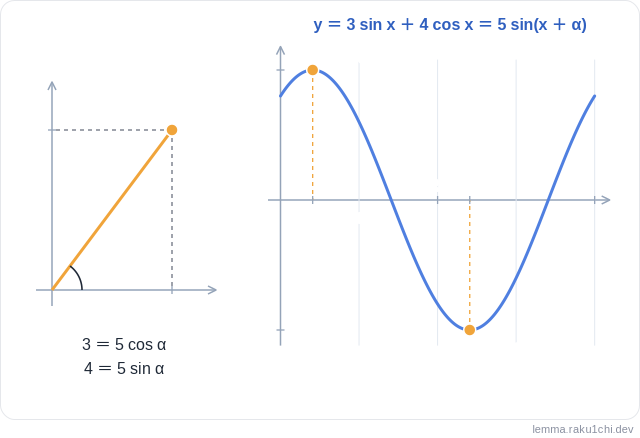
問題 5.7 ★★ f ( x ) = 3 sin x + 4 cos x f(x) = 3\sin x + 4\cos x f ( x ) = 3 sin x + 4 cos x sin x \sin x sin x cos x \cos x cos x
ヒント 1
公式 5.17 で r sin ( x + α ) r\sin(x + \alpha) r sin ( x + α ) α \alpha α cos α \cos\alpha cos α sin α \sin\alpha sin α
ヒント 2
最大になるのは sin ( x + α ) = 1 \sin(x + \alpha) = 1 sin ( x + α ) = 1 x x x α \alpha α
解答
点 ( 3 , 4 ) (3, 4) ( 3 , 4 ) 5 5 5 α \alpha α cos α = 3 5 \displaystyle \cos\alpha = \frac{3}{5} cos α = 5 3 sin α = 4 5 \displaystyle \sin\alpha = \frac{4}{5} sin α = 5 4 公式 5.17 より f ( x ) = 5 sin ( x + α ) f(x) = 5\sin(x + \alpha) f ( x ) = 5 sin ( x + α ) 5 5 5 − 5 -5 − 5 x + α = π 2 + 2 n π \displaystyle x + \alpha = \frac{\pi}{2} + 2n\pi x + α = 2 π + 2 nπ n n n x = π 2 − α + 2 n π \displaystyle x = \frac{\pi}{2} - \alpha + 2n\pi x = 2 π − α + 2 nπ sin x = sin ( π 2 − α ) = cos α = 3 5 \displaystyle \sin x = \sin\left(\frac{\pi}{2} - \alpha\right) = \cos\alpha = \frac{3}{5} sin x = sin ( 2 π − α ) = cos α = 5 3 cos x = cos ( π 2 − α ) = sin α = 4 5 \displaystyle \cos x = \cos\left(\frac{\pi}{2} - \alpha\right) = \sin\alpha = \frac{4}{5} cos x = cos ( 2 π − α ) = sin α = 5 4 sin ( π 2 − θ ) = cos θ \displaystyle \sin\left(\frac{\pi}{2} - \theta\right) = \cos\theta sin ( 2 π − θ ) = cos θ cos ( π 2 − θ ) = sin θ \displaystyle \cos\left(\frac{\pi}{2} - \theta\right) = \sin\theta cos ( 2 π − θ ) = sin θ 5.6 節の証明で導いた式です。このとき f ( x ) = 3 ⋅ 3 5 + 4 ⋅ 4 5 = 5 \displaystyle f(x) = 3 \cdot \frac{3}{5} + 4 \cdot \frac{4}{5} = 5 f ( x ) = 3 ⋅ 5 3 + 4 ⋅ 5 4 = 5
問題 5.8 ★★ 0 ≤ θ < 2 π 0 \leq \theta < 2\pi 0 ≤ θ < 2 π 2 cos 2 θ + 3 sin θ − 3 = 0 2\cos^2\theta + 3\sin\theta - 3 = 0 2 cos 2 θ + 3 sin θ − 3 = 0 sin θ + cos θ > 1 \sin\theta + \cos\theta > 1 sin θ + cos θ > 1
ヒント 1
(1) は、5.8 節の終わりで述べた、sin θ \sin\theta sin θ 公式 5.17 )。
ヒント 2
(1) は、cos 2 θ \cos^2\theta cos 2 θ sin θ \sin\theta sin θ t t t θ \theta θ t t t
解答
(1) cos 2 θ = 1 − sin 2 θ \cos^2\theta = 1 - \sin^2\theta cos 2 θ = 1 − sin 2 θ 2 − 2 sin 2 θ + 3 sin θ − 3 = 0 2 - 2\sin^2\theta + 3\sin\theta - 3 = 0 2 − 2 sin 2 θ + 3 sin θ − 3 = 0 2 sin 2 θ − 3 sin θ + 1 = 0 2\sin^2\theta - 3\sin\theta + 1 = 0 2 sin 2 θ − 3 sin θ + 1 = 0 s = sin θ s = \sin\theta s = sin θ 2 s 2 − 3 s + 1 = 0 2s^2 - 3s + 1 = 0 2 s 2 − 3 s + 1 = 0 s = 3 ± 9 − 8 4 = 3 ± 1 4 \displaystyle s = \frac{3 \pm \sqrt{9 - 8}}{4} = \frac{3 \pm 1}{4} s = 4 3 ± 9 − 8 = 4 3 ± 1 s = 1 2 , 1 \displaystyle s = \frac{1}{2},\ 1 s = 2 1 , 1 − 1 ≤ s ≤ 1 -1 \leq s \leq 1 − 1 ≤ s ≤ 1 sin θ = 1 2 \displaystyle \sin\theta = \frac{1}{2} sin θ = 2 1 θ = π 6 , 5 π 6 \displaystyle \theta = \frac{\pi}{6},\ \frac{5\pi}{6} θ = 6 π , 6 5 π 5.8 節の図)、sin θ = 1 \sin\theta = 1 sin θ = 1 θ = π 2 \displaystyle \theta = \frac{\pi}{2} θ = 2 π θ = π 6 , π 2 , 5 π 6 \displaystyle \theta = \frac{\pi}{6},\ \frac{\pi}{2},\ \frac{5\pi}{6} θ = 6 π , 2 π , 6 5 π
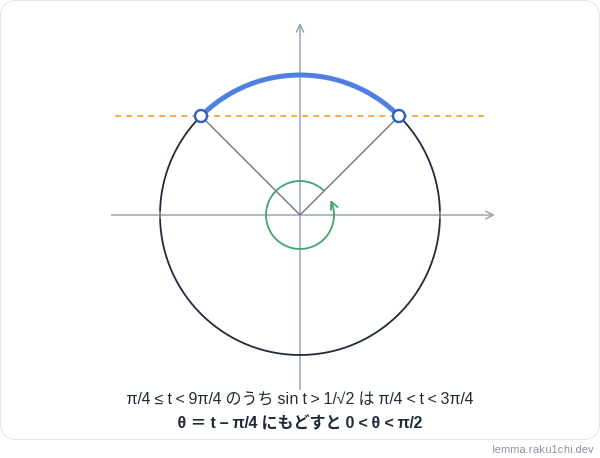
(2) 点 ( 1 , 1 ) (1, 1) ( 1 , 1 ) 2 \sqrt{2} 2 π 4 \displaystyle \frac{\pi}{4} 4 π 公式 5.17 より不等式は sin ( θ + π 4 ) > 1 2 \displaystyle \sin\left(\theta + \frac{\pi}{4}\right) > \frac{1}{\sqrt{2}} sin ( θ + 4 π ) > 2 1 t = θ + π 4 \displaystyle t = \theta + \frac{\pi}{4} t = θ + 4 π π 4 ≤ t < 9 π 4 \displaystyle \frac{\pi}{4} \leq t < \frac{9\pi}{4} 4 π ≤ t < 4 9 π 1 2 \displaystyle \frac{1}{\sqrt{2}} 2 1 π 4 < t < 3 π 4 \displaystyle \frac{\pi}{4} < t < \frac{3\pi}{4} 4 π < t < 4 3 π t = π 4 \displaystyle t = \frac{\pi}{4} t = 4 π 1 2 \displaystyle \frac{1}{\sqrt{2}} 2 1 θ = t − π 4 \displaystyle \theta = t - \frac{\pi}{4} θ = t − 4 π 0 < θ < π 2 \displaystyle 0 < \theta < \frac{\pi}{2} 0 < θ < 2 π